
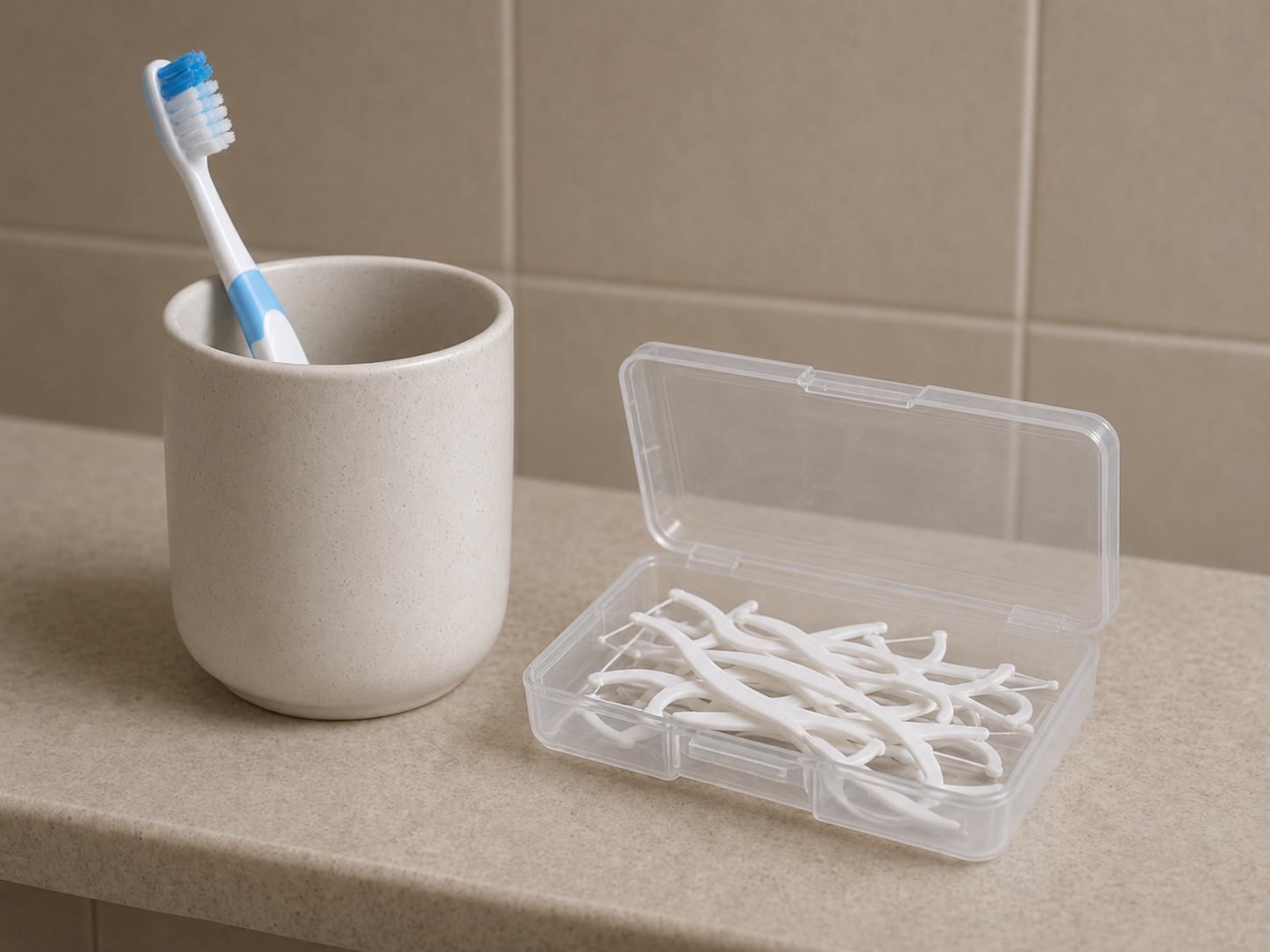
The short answer: a good approach is to clean between your teeth before brushing. This sequence may help remove interdental plaque first, allowing fluoride toothpaste to reach those areas more effectively. Brushing alone cleans the facial, lingual, and occlusal surfaces; it does not reliably clean where two teeth meet. Consistency still matters more than order.
Missing the spaces entirely is the larger clinical gap. This article outlines the anatomy, how ADA guidance relates to a clinical trial on sequence, and how we select tools in a health-first practice.
1. Why the order question matters
Patients who brush carefully yet bleed only between certain teeth are usually not failing at brushing. Toothbrush bristles are designed for the outer, inner, and chewing surfaces. The contact area between adjacent teeth is too narrow for those bristles to clean consistently.
When plaque remains at the contact, the gum papilla is more likely to stay inflamed. The routine can feel complete while the tissue between the teeth does not. Sequence will not change anatomy — it can make the tools you already use address the site they were meant for.
2. What the toothbrush cannot reach
Interdental plaque is a frequent starting point for gingivitis. Floss, an interdental brush, or both — matched to each embrasure — remove biofilm from the proximal surfaces. Without that step, plaque can accumulate where inflammation often begins.
Healthy gums are a prerequisite before shade, contour, or any cosmetic discussion. Inflamed tissue alters how a smile appears and how restorations are maintained. Daily interdental cleaning is preventive care, not an optional add-on.
Flossing before brushing may offer additional benefits, but consistency matters more than the order — clean between the teeth every day, then brush with fluoride toothpaste. Dr. Min Hee Oh
3. Floss first, then brush — the clinical rationale
A small randomized crossover clinical trial involving 25 dental students found that flossing before brushing resulted in greater interdental plaque reduction and higher fluoride concentrations in interdental plaque than brushing before flossing. The proposed mechanism is practical: clear the contact, then brush so toothpaste reaches the cleaned margins.
The American Dental Association (ADA) considers either sequence acceptable, provided that interdental cleaning is performed thoroughly and consistently. However, this clinical trial suggests that flossing before brushing may offer additional benefits in reducing interdental plaque and improving fluoride retention.
While these findings support a floss-first routine, the study was relatively small and does not establish that this sequence is necessary for every patient. If you already floss after brushing every day without missing sites, keep that consistency. If you are establishing the habit, interdental cleaning → brush is a reasonable default.
4. Floss or interdental brush?
Floss is appropriate for tight contacts where a brush wire cannot pass safely. Soft interdental brushes clean open or slightly open embrasures more efficiently when the filaments contact both tooth walls and the wire does not bind. Anterior and posterior sites often require different diameters.
A brush that is too large can traumatize the papilla. A brush that drops through without resistance leaves plaque on the walls. In the office we map bleeding sites and size each embrasure — more reliable than a single “one-size” pack chosen at random.
What you may be noticing
| What you notice | A possible factor | A useful first step |
|---|---|---|
| Bleeding only between teeth | Plaque and inflammation at the contact | Add gentle daily interdental cleaning |
| Food always traps in one spot | Open contact, chip, or restoration margin | Clinical evaluation — the filling or restoration may need correction |
| Floss shreds or will not pass | Rough edge, overhanging filling, or very tight contact | Do not force; have the site examined |
| Brush feels fine; gums still puffy | Persistent interdental plaque | Floss-first sequence + correctly sized tool |
| Water flosser only | Needs vary by site, device, and oral health | Ask whether it is enough alone or should be combined with floss or an interdental brush |
This guide is educational, not a diagnosis. Bleeding, pain, or a sudden change in how floss fits should be evaluated in person.
5. A clear daily sequence
- Once daily — choose a time that fits your routine. Many patients find it easiest to clean between their teeth as part of their bedtime routine.
- Interdental cleaning first (our preferred default) — floss or the sized interdental brush at each site.
- Then brush — two minutes with fluoride toothpaste, gentle pressure along the gumline.
- Avoid trauma — excessive force or snapping floss into the papilla causes injury, not cleaner contacts.
If a contact never accepts floss or a brush safely, the limitation is often anatomic or restorative — crowding, an overhanging margin, or active inflammation — not patient effort alone. Those findings belong in a clinical exam before home care can work as intended. Our general dentistry visits include site-specific instruction and tool sizing.
The honest bottom line
The order can help optimize your routine, but consistency matters most. Cleaning between your teeth every day, using the right tool for each space, is one of the simplest ways to support long-term gum health. Flossing before brushing may offer additional benefits for plaque and fluoride at the contacts — and stable gums remain the foundation under any natural-looking smile we plan.
References
- Mazhari F, et al. The effect of toothbrushing and flossing sequence on interdental plaque reduction and fluoride retention: A randomized controlled clinical trial. Journal of Periodontology. 2018;89(7):824–832. PubMed: 29741239 · DOI: 10.1002/JPER.17-0149
- American Dental Association. Floss/Interdental Cleaners. ADA Oral Health Topics